What to Put in Your Pet's Digital Health Profile (And Why It Matters)
By the Petso Editorial Team · Published 6/15/2026
What to Put in Your Pet’s Digital Health Profile (And Why It Matters)
Sarah’s golden retriever, Biscuit, swallowed something he shouldn’t have on a Saturday afternoon. By the time she reached the emergency vet, the receptionist needed his weight, his current medications, his vaccination history, and whether he’d had any prior gastrointestinal issues. Sarah had most of that information — somewhere — scattered across paper records, a phone gallery, and half-remembered conversations with her regular vet.
That experience is more common than it should be, and it’s exactly the kind of situation a well-built digital health profile exists to prevent. When everything your pet’s care team needs lives in one organised, accessible place, you spend less time scrambling and more time focusing on what matters: your pet.
Here’s a clear, practical breakdown of everything worth including in your pet’s digital health profile on Petso — and the reason each piece of information earns its place.
Core Identity Information
Before you get to medical history, you need a solid foundation of basic identity details. This is the information that helps any vet, shelter worker, or good Samaritan identify your pet quickly and connect them back to you.
- Full name and any nicknames — sounds simple, but consistency matters if records ever need to be cross-referenced.
- Species, breed, age, and date of birth — breed-specific health tendencies inform treatment decisions more than many owners realise.
- Sex and reproductive status — spayed, neutered, or intact, along with the approximate date of any procedure.
- Coat colour, markings, and distinguishing features — a written description alongside photos makes identification reliable even if a microchip can’t be scanned.
- Microchip number and registry — store both the number and which registry it’s enrolled in, because there’s more than one.
- A clear, recent photograph — ideally one that shows the face and a full body shot. Update it annually or after any significant physical change.
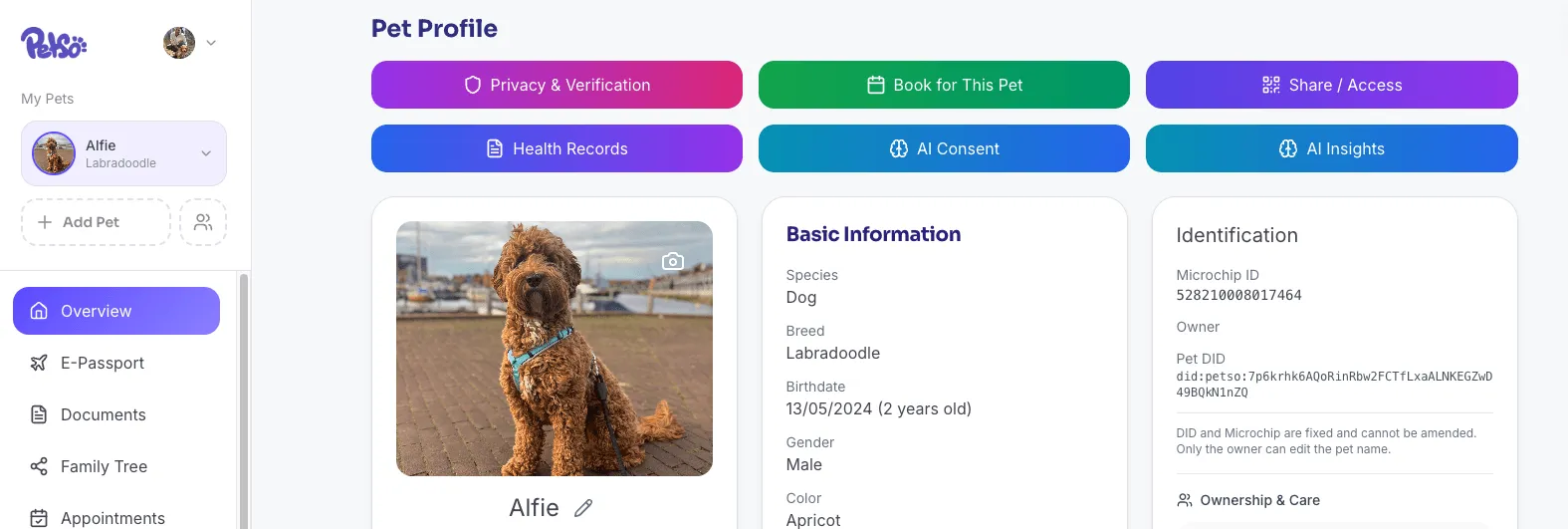
On Petso, this core identity layer is also what powers the global lost-pet search tool. A complete profile means a found-pet report can be matched to you faster, wherever in the world it happens.
Vaccination Records
Vaccination history is one of the most frequently requested pieces of information in veterinary care, boarding, grooming, and travel — and one of the hardest to reconstruct if paper records are lost.
For each vaccine, record:
- The vaccine name (e.g., DHPP, rabies, bordetella, feline leukemia)
- The date administered
- The administering vet or clinic
- The due date for the next booster
Keeping this current means you’ll never arrive at a boarding kennel only to discover your records are a year out of date. It also gives any emergency vet an immediate picture of your pet’s immune status — relevant if they’re presenting with symptoms that could indicate a preventable disease.
Current Medications and Supplements
This section should be treated as a living document, updated every time something changes.
Include:
- Prescription medications — name, dosage, frequency, prescribing vet, and start date
- Preventative treatments — flea, tick, and heartworm prevention, including the brand and dose schedule
- Over-the-counter supplements — joint support, probiotics, omega-3s, and similar products
- Any medications recently discontinued — and the reason why, if known
Drug interactions are a real risk in veterinary medicine. A complete medication list helps any vet — especially one meeting your pet for the first time — make safer, faster decisions.
Allergies and Adverse Reactions
This is arguably the most critical section in an emergency context. Be specific and err on the side of too much detail.
- Food allergies or intolerances — ingredient level, not just brand level (e.g., chicken protein, not just “Brand X food”)
- Environmental allergies — grass, dust mites, specific pollens
- Medication sensitivities — any drug that caused a reaction, what the reaction was, and how severe
- Material or contact sensitivities — latex gloves, certain topical products
If your pet has had an anaphylactic or serious adverse reaction in the past, note it prominently. Some owners add a short summary note at the very top of the profile for exactly this reason.
Medical History and Diagnoses
A chronological health history gives vets meaningful context that a single visit never can. Include:
- Past diagnoses — both resolved conditions and ongoing ones
- Surgeries and procedures — dates, outcomes, and the performing vet or specialist
- Hospitalisations — reason, duration, and treating facility
- Significant test results — bloodwork panels, imaging reports, biopsy results
- Dental history — dates of professional cleanings and any extractions
You don’t need clinical language. Plain descriptions like “had a lump removed from left shoulder, benign, July 2023” are perfectly useful. The goal is a timeline any vet can scan quickly.
Vet and Specialist Contacts
Store contact information for everyone involved in your pet’s care:
- Primary vet — name, clinic, phone, and address
- Specialists — cardiologist, dermatologist, oncologist, or any other specialist your pet sees
- Emergency vet clinic — the one you’d actually go to at 2am, already looked up and saved
- Behaviourist or trainer — relevant if your pet has anxiety or behavioural considerations that affect how they should be handled
In a genuine emergency, you won’t want to be searching for a phone number. Having it already in the profile means you — or anyone helping you — can act immediately.
Nutrition and Feeding Details
This section matters more than most owners initially expect. It supports both routine care handoffs (when a pet-sitter or family member takes over) and medical decision-making (when a vet needs to rule out dietary causes).
Record:
- Current food brand, product name, and flavour
- Daily portion size and feeding schedule
- Any foods your pet loves as treats — and any they react badly to
- Water intake habits, if your pet is prone to drinking too little or too much
- Any prescription or therapeutic diet, with the prescribing vet noted
Behavioural Notes
Behavioural context helps anyone caring for your pet do so safely and compassionately — especially in a stressful environment like a vet clinic or shelter.
Useful things to note:
- Fear triggers or anxiety around specific things (strangers, other animals, loud noises, car travel)
- How your pet responds to being handled or restrained
- Any history of fear-based reactivity or biting
- What helps them feel calm — a favourite toy, a particular way of being approached
- Whether they’re good or challenging with other animals and children
This isn’t about labelling your pet; it’s about setting care teams up to have positive interactions with them. A note that says “very nervous at the vet, does best when given a few minutes to settle before examination” is genuinely helpful information.
Insurance Details
If your pet is insured, keep the following in the profile:
- Insurance provider and policy number
- Cover level and any exclusions you know about
- Emergency claims contact number
- Renewal date
Having this on hand means you can authorise treatment faster and avoid making care decisions under financial uncertainty when you’re already stressed.
How Petso Makes This Manageable
Filling in all of the above can feel like a significant task when you look at it as a whole. In practice, most of the information you already have — it’s just scattered across paper, emails, and memory.
Petso’s digital profile is designed to let you build this out incrementally. Add what you know today, fill in the gaps over the next few weeks as you dig out records or attend upcoming vet appointments, and then keep it updated as things change. The platform stores everything securely, keeps a version history so nothing is lost, and ties your pet’s profile to a verifiable digital identity that travels with them anywhere in the world.
For pet owners who’ve experienced that panicked moment of not being able to answer a vet’s basic question about their own animal, the relief of having a complete, accessible profile isn’t just convenient — it’s genuinely transformative.
A Note on Keeping It Current
A digital health profile is only as useful as it is accurate. Build a simple habit of updating it:
- After every vet visit — add any new diagnoses, medication changes, or test results
- When starting or stopping a medication — update immediately
- Annually — do a full review, refresh the photo, and check that all contact details are still correct
- After a boarding or travel experience — note anything new that came up
Treating it as a living record rather than a one-time setup task is what makes it genuinely valuable when you need it most.
Conclusion
Your pet can’t tell a vet what medications they’re on, what they’re allergic to, or what happened three years ago that might be relevant right now. That information lives with you — and a complete digital health profile is how you make sure it’s always accessible, accurate, and ready when it counts.
Start with what you know. Fill in the rest as you go. The version of you standing in an emergency vet clinic at an unexpected hour will be genuinely grateful you did.
FAQ
How much time does it take to set up a pet health profile on Petso?
Most owners complete a solid first version in 20 to 30 minutes if they have their pet’s vet records nearby. You don’t need everything to be perfect on day one — start with core identity details and vaccination records, then add layers over time.
What if I don’t have all my pet’s historical medical records?
Start with what you know and what you can confirm from memory. You can request copies of past records from your vet clinic, and many practices can email these quickly. Even a partial profile is significantly more useful than none.
Is my pet’s health information secure on Petso?
Petso is built with privacy and security as foundational priorities. Your pet’s data is stored securely, and you control what’s shared and with whom. The platform’s blockchain-backed identity layer adds an additional layer of verifiability without making your pet’s sensitive information publicly visible.
Can I share my pet’s profile with my vet directly?
Yes. Petso is designed to make sharing straightforward — you can provide access to a vet, a boarding facility, or a pet-sitter as needed, without surrendering control of the overall profile.
Do I need a separate profile for each pet?
Yes, and that’s intentional. Each pet gets their own unique digital identity with their own complete health record, so information never gets mixed up — which matters more than it might seem if you have multiple pets on similar medications or with similar health histories.
What if my pet is lost and someone finds them — can they access the profile?
If your pet’s Petso digital ID is scanned or looked up through the global lost-pet search tool, the finder can see the contact information you’ve chosen to make visible and initiate a connection with you. You remain in control of what medical detail is surfaced in that scenario versus what’s reserved for care providers.